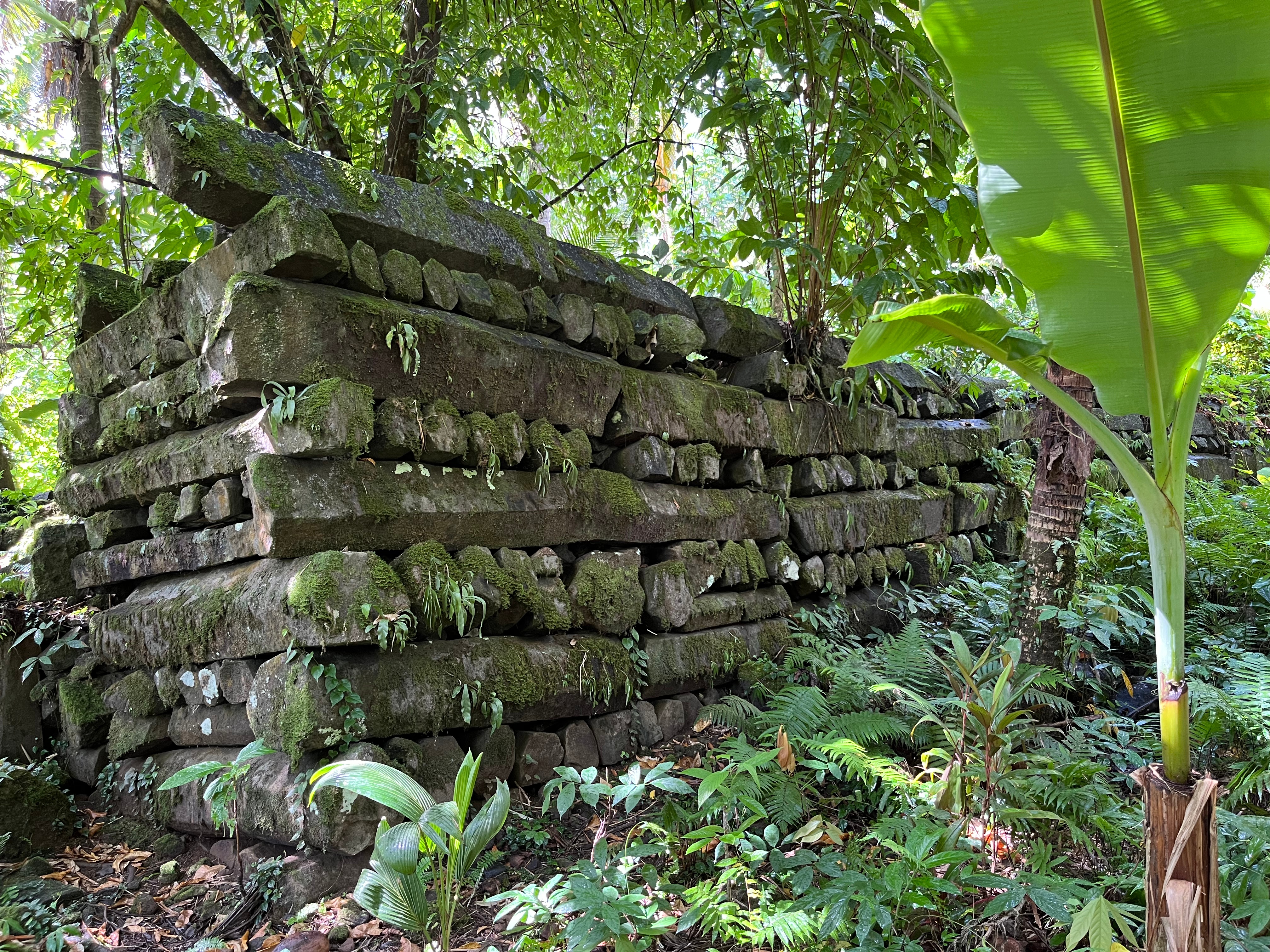
If you’re a history buff or you’ve spent any wasted time watching shows like The Unexplained, Ancient Aliens, or Unbelievable then you’ve probably heard of the ruins of Nan Madol.
The quick overview is that Nan Madol is an archeological site on the east side of the island of Pohnpei, in Micronesia. It was the former capital of the Saudeleur dynasty until the early seventeenth century. A collection of islands separated by small canals, the place is now a decaying series of basaltic stone and coral constructions and defensive walls. (Stole this part from Wikipedia.)
The place gets continuous billing on TV shows because some of the basalt rocks which were used to construct the various architectural pieces are considered too large to have been moved naturally (insert your random conspiracy theory here).
The site has been field researched by legitimate scientists from different colleges and universities over the decades and is a well documented place. In 1985 the ruins were declared a National Historical Landmark.
The ruins have always been kind of on my radar of interesting places to go. I like stuff that’s off the beaten tourist path. Places like Machu Pichuu and Angkor Wat have always held an irresistible charm that I blame on Indiana Jones. So, when my travels naturally took me through Pohnpei anyway, it was an optimal time to stop and investigate for myself.

A display of Japanese tanks left over from World War Two activity. Steel hulks slowly corroding in the Pacific salt weather. A side stop on the return trip from the ruins. (it’s not a trick of the picture. They are REALLY small.)
General Information
Weather – The weather in March of 2025 was akin to the previous stop in Chuuk. The days were a shifting affair from bright sun and puffy clouds to straight-down pouring rain, and back again. Honestly, it doesn’t affect your day. It didn’t affect mine at all. The canopy in the area around the ruins and the waterfalls is thick and stops most of the rain from getting to the ground with any force behind it. Besides, you have to wade across a couple of wide canals to get into the ruins, so you’re already mostly soaked from the start.
Money – The US dollar was the currency of choice for everything I did while on Pohnpei. My credit card transactions also went through without a currency conversion. As they say, the dollar is the standard.
Passport/Visa – The customs officer at the Pohnpei airport stamped my passport, which I thought was quite nice. You will also have to fill out an agricultural form which stays with your passport during your stay on the island. Otherwise, it was pretty quiet on this front. I traveled in and out on your standard blue American passport and had no issues. I also required no visa. Travelers from other parts of the globe will want to check on the visa situation before going.
There is a departure tax which is paid in cash. Make sure that you save enough dollars to escape the island.
Language Barrier – Where the country of Micronesia has its own language, American English is spoken pretty much everywhere. The island is basically bilingual-enough for you to get along without learning any new words.
Getting In and Out
If you read the last post about Chuuk Lagoon then you understand that there is really only one way to get around Micronesia unless you own your own boat. That way is the United Airlines Island Hopper flight. It flies in an arch from Honolulu to Guam, crossing the Marshall Islands and Micronesia as it goes. It goes in one direction on one day, and then back the other way on the next day. This is important when making your travel arrangements, as it may not be going in the direction you want on the day you want to travel. This inconvenience is part of the mystique of banging around the vast Pacific Ocean. It plans to plan.
I was headed back to Kwajalein from Chuuk and had to fly through Pohnpei on the way. This made the stop easy enough for me to incorporate into a larger travel agenda. It became a tight squeeze to do what I wanted to do in a day and a half, but with some help from the hotel, it worked out fine.
My Headquarters
My bunkhouse for the day and a half I was on Pohnpei was the Mangrove Bay Hotel. The hotel sits on the edge of the lagoon just south of the Pohnpei International Airport, on the north edge of the island. It can be reached via email to set up reservations. I chose the Mangrove Bay Hotel based on reviews from friends who had stayed there and its ability to set up excursions for visitors.
The hotel has several redeeming qualities. These include airport transfers, and it being the home of the Pohnpei Surf Club. Granted I didn’t want to go surfing, but the Surf Club gang also handles full day excursions to the ruins of Nan Madol. Oh, in-room AC and an onsite bar were also pluses.
Quick note: in March the hotel restaurant and bar was closed on Mondays due to a general lack of people wanting to work on the island. There is another hotel at the top of the hill with an open restaurant. The walk is quick enough to not be inconvenient.

The view from my room at the hotel. All of the rooms have balconies overhanging the lagoon.

The outdoor restaurant and bar area at the hotel. It was an excellent place to enjoy a half-dozen beers and take in the view.
Highlights from the Ruins
My hotel was on the north end of the island. The ruins were on the southern end of the east side. So, the day trip went something like everybody piled in a, not to well worn, SUV and drove a good hour around the outside of the island. (The island is basically a volcanic mound, so you can’t drive straight across it.)
Once at the park complex, the guide paid for everyone’s tickets and lead the group both to and through the ruins. The walk into the area wqs about 30 minutes of muddy track laid out like a snake. A half dozen homemade bridges were stacked together to allow you to cross the smaller creeks and canals. The deeper and wider canals you will wade across holding your stuff over your head and hoping you don’t fall down.
Once in the main area of the complex the guide walked us around in a general circle, explaining the main topics of interest as he went. All in all, it was completely worth the canal wading to get there.
Important Point: if you’re looking for a history lesson or a deep dive into the culture that built it, as you might get from a major site in some other country, this is not it. If you want that of the experience, watch some documentaries before you go. What you are going to get is a guided general walk around. Still, it was a good way to spend a day.

Part of the land-side defensive wall. This section had been cleared to make it more visible as it was directly along the entrance trail.

Part of the canal system that runs throughout the complex. The canals are shallow in places and deep in others making crossing them sketchy.
A quick view of the entrance to the main complex area.

An interior view of the main complex area. I was a multi-tiered square enclosure with a suspected royal tomb at its middle. (according to the guide)

The front-facing section of the tomb. The structure was long-since emptied out.

The outside area of Nan Madol. The canals exit out to the bigger lagoon area and into deeper tidal water.
Closing Thoughts
The stop in Pohnpei on the way back to Kwajalein was a nice capper for my trip off-island. The people at the hotel and the surf club were super friendly. The general town of Pohnpei was much less austere than Chuuk had been. The ruins themselves were cool, in a generally interesting sort of way, considering they weren’t difficult to get to. I doubt I would have traveled into the pacific intentionally to see them, but since I was stopping on the island anyway it was a good time.

A view of a waterfall stop on the return trip from the ruin. The waterfall was a special place in the local history of the island.
Getting out and seeing what there is to see in the world is one of the things that makes life interesting. Ruins of abandon structures and stories of long dead cultures add to that excitement. Get out and explore the world. It’s worth your time. Well, that’s my opinion.
Leave a Reply